

How Long Does a Tesla Battery Last? Real 2026 Data
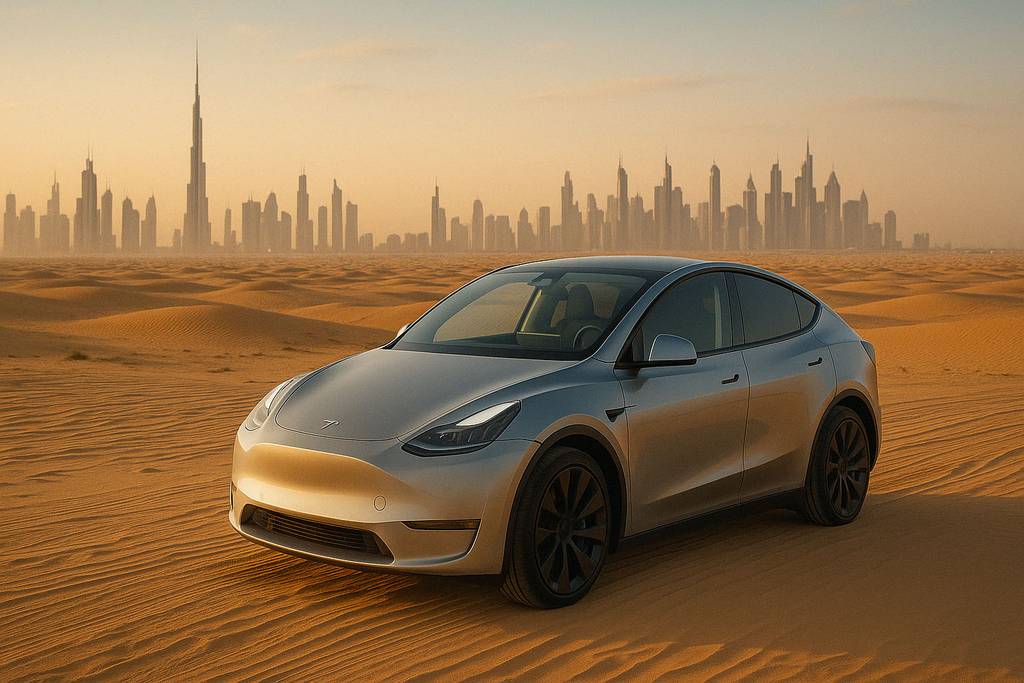
Short answer: a Tesla battery is built to outlast most ownership cycles. Tesla's own fleet data shows Model S and Model X packs keeping about 88% of their capacity after 200,000 miles (roughly 320,000 km), and Model 3 and Model Y Long Range packs keeping about 85%. Independent battery tracker Recurrent says a healthy Tesla pack generally won't need replacing before 15 years. In very hot climates like the UAE the clock runs somewhat faster, which is exactly why the way you charge and park matters.
This guide brings together the most reliable numbers available in 2026 — Tesla's Impact Reports, Recurrent's real-world owner data and Geotab's study of more than 22,700 electric vehicles — and turns them into plain answers: how many years and kilometres you can expect, what wears a pack out, and what to do about it if you drive a Tesla in the Gulf.
Key takeaways
- Capacity after 320,000 km: about 88% for Model S/X and about 85% for Model 3/Y Long Range, according to Tesla's Impact Reports.
- Typical loss: Tesla batteries lose roughly 1–2% of range a year, most of it in the first 80,000 km or so.
- Biggest stressors: frequent high-power DC fast charging and sustained heat.
- UAE warranty: 8 years with at least 70% capacity retained, covering 160,000 km to 240,000 km depending on the model.
- Replacements are rare: about 0.3% of EVs built from 2022 onwards have needed a new battery outside of recalls.
How long does a Tesla battery last in years and kilometres?
There are two ways to think about battery life: how long before the pack fails outright, and how long before it loses enough capacity that you notice a shorter range. Outright failures are uncommon. Gradual capacity loss is something every owner experiences, and it is slow.
The US Department of Energy estimates that EV batteries may last 12 to 15 years in moderate climates and 8 to 12 years in severe climates (fueleconomy.gov). Recurrent, which monitors battery health across tens of thousands of real cars, is more optimistic about Teslas specifically: in its view, healthy packs "generally will not need replacement before 15 years" (Recurrent).
In distance terms, Tesla's published fleet data runs out to 200,000 miles, about 320,000 km, and even at that point the average pack still holds 85–88% of its original capacity. A driver covering 20,000 km a year would need 16 years to reach that distance.
What the data says
| Source | What it measured | Finding |
|---|---|---|
| Tesla 2022 Impact Report | Model S and Model X fleet | About 12% capacity loss after 200,000 miles (≈320,000 km) |
| Tesla 2023 Impact Report | Model 3 and Model Y Long Range fleet | About 15% capacity loss after 200,000 miles |
| Recurrent | Real-world range of Model 3 and Model Y | Model 3: 95% after 3 years, 93% after 5. Model Y: 96% after 3 years, 95% after 5 |
| Geotab (2026) | 22,700+ EVs across 21 models, all brands | Average loss of 2.3% a year, projecting about 81.6% capacity after 8 years |
The pattern is consistent: a noticeable drop in the first couple of years, then a long, flat curve. Recurrent notes that most of the typical 1–2% yearly loss happens in roughly the first 50,000 miles (about 80,000 km). Reporting on Tesla's figures by Electrek shows the same shape for early Model 3 and Model Y data.
Geotab's average is higher than Tesla's because it covers every brand and because fast charging has become far more common in recent years (Geotab). That trend matters for Tesla owners too, as the next sections explain.
Tesla battery life by model
Model 3 and Model Y
The best-selling Teslas also have the most data behind them. Long Range and Performance versions use nickel-based cells, while Standard and Rear-Wheel Drive versions in many markets use LFP (lithium iron phosphate) cells. Both chemistries age well, but they want to be charged differently, as covered below. You can check which one your car has under Controls > Software > Additional Vehicle Information.
Driving one in the UAE? Our Tesla Model 3 and Tesla Model Y service pages cover the maintenance each model needs.
Model S and Model X
The larger packs in the Model S and Model X have the longest track record. Tesla's figure of roughly 12% loss after 200,000 miles means a well-kept, high-mileage Model S still has most of its original range, and Recurrent reports that many older Model S cars still show around 80% of the range they had when new.
What makes a Tesla battery wear out faster?
1. Frequent high-power DC fast charging
Geotab calls high-power DC fast charging "the single largest stressor" on battery health. Vehicles that charged mostly at lower power lost about 1.5% of capacity a year, while those doing more than 40% of their sessions above 100 kW lost about 3.0% a year, double the rate. Supercharging on a road trip is exactly what the car is designed for; relying on it every day is what adds up.
2. Heat
In Geotab's data, vehicles in hot climates (more than 35% of days above 25°C) degraded about 0.4 percentage points a year faster. Tesla's thermal management system works hard to protect the pack, but a car that sits in direct sun at 45°C and is then fast-charged is asking a lot of it. Our guide to how Dubai's heat affects EV battery life explains what happens inside the cells.
3. Living at very high or very low charge
State of charge matters less than many owners assume, but only up to a point. Geotab found it became a real factor when a vehicle spent more than 80% of its time below 20% or above 80% charge, which raised degradation to about 2.0% a year.
4. Letting the battery run completely flat
A fully drained high-voltage battery is bad news, and Tesla's Middle East warranty specifically excludes damage caused by running the battery flat until the car can't be driven and not recharging it within two weeks. If you're leaving your Tesla for a long summer break, read what happens when an EV is parked for months before you go.
Does UAE heat shorten Tesla battery life?
Somewhat, but not dramatically, and a lot of it is within your control. The DOE's estimate of 8–12 years in severe climates against 12–15 years in moderate ones, and Geotab's yearly penalty of about 0.4 points for hot regions, both point the same way: heat speeds up the chemistry that causes capacity loss.
What makes the bigger difference in the Gulf is the behaviour on top of the heat: parking in shade or covered parking where possible, avoiding back-to-back fast charges on an already hot pack, and keeping the car plugged in during long stays so the thermal system can look after the battery. Our guide to fast charging and battery health in the UAE goes deeper on the charging side.
How to make your Tesla battery last longer
- Follow Tesla's charge limit for your battery type. For nickel-based packs, Tesla recommends keeping the daily limit below 90% and charging to 100% only for long trips. For LFP packs, Tesla recommends leaving the limit at 100% and charging fully at least once a week.
- Use AC charging day to day. Home or workplace AC charging is gentler on the cells than repeated high-power DC sessions.
- Save Supercharging for road trips. Occasional fast charging is normal use; daily fast charging is what accelerates wear.
- Park in the shade. Less heat soak means less work for the cooling system and less stress on the pack.
- Don't leave a nickel-based pack sitting near 0% or 100% for long periods. LFP packs are the exception, as Tesla recommends keeping them charged.
- Never let the car run completely flat, especially before a long absence.
- Keep the software up to date. Tesla delivers vehicle updates over the air, and a current version gives you the latest charging features.
- Get a battery health check if your range drops suddenly rather than gradually.
How to check your Tesla's battery health
A slow decline of a percent or two a year is normal; a sudden, noticeable drop in range is worth investigating. You can get a rough idea from the car's own range estimates, and our step-by-step guide on how to check Tesla battery capacity walks through the methods owners use. For a proper diagnosis, EVS offers battery health and thermal management checks that go well beyond the range number on the screen.
When does a Tesla battery need replacing, and what is covered?
Very rarely, and usually within warranty. Recurrent's research across more than 30,000 EVs found that fewer than 4% have ever had a battery replaced outside of recalls, falling to about 0.3% for vehicles from 2022 onwards, although it did note an uptick among 2019–2021 Teslas (Recurrent research).
In the UAE, Tesla's New Vehicle Limited Warranty covers the battery and drive unit for 8 years or the distance below, whichever comes first, with a minimum of 70% capacity retained over that period:
| Model | Battery & drive unit warranty (UAE) |
|---|---|
| Model S / Model X | 8 years or 240,000 km |
| Model 3 / Model Y Long Range and Performance | 8 years or 192,000 km |
| Model 3 / Model Y Standard | 8 years or 160,000 km |
Gradual capacity loss that stays above the 70% line is treated as normal wear and isn't covered, and neither is damage from collisions, flooding or the pack being opened by non-certified personnel. The full terms are in Tesla's Middle East warranty document.
Out of warranty, a new pack is expensive: Recurrent's invoice research puts Tesla battery replacements at roughly US$15,000–22,000, which is about AED 55,000–81,000. Many range problems, however, trace back to a module, a cooling fault or the battery management system rather than the whole pack, which is why a proper diagnosis from a high-voltage battery repair specialist should always come before a replacement quote.
Frequently asked questions
How many years does a Tesla battery last?
Most Tesla batteries are expected to last well over a decade. The US Department of Energy estimates 12–15 years in moderate climates and 8–12 years in severe ones, while Recurrent says healthy Tesla packs generally won't need replacing before 15 years.
How many kilometres can a Tesla battery do?
Tesla's data shows packs still holding about 85–88% of their capacity after 200,000 miles (around 320,000 km), so for most owners the battery isn't what limits the car's life.
How long does a Tesla battery last without charging?
A parked Tesla loses a small amount of charge every day, and more if features such as Sentry Mode or Cabin Overheat Protection are running. A few days won't hurt the pack, but don't let it run flat: Tesla's Middle East warranty excludes a battery left fully discharged without recharging for two weeks.
Does Supercharging damage a Tesla battery?
Occasional Supercharging doesn't meaningfully harm the battery. Heavy, frequent use of high-power DC charging does speed up wear: Geotab measured about 3.0% capacity loss a year for the heaviest fast-charging users against 1.5% for light users.
Should I charge my Tesla to 80%, 90% or 100%?
It depends on the battery chemistry. Tesla recommends keeping nickel-based packs below 90% for daily driving, and keeping LFP packs at 100% with a full charge at least once a week. Check your pack type under Controls > Software > Additional Vehicle Information.
Is Tesla battery degradation covered by warranty?
Only if capacity falls below 70% within the warranty period, which in the UAE is 8 years and 160,000–240,000 km depending on the model. Normal gradual loss above that level is not covered.
Does hot weather shorten Tesla battery life?
Yes, modestly. Geotab found that vehicles in hot climates degrade about 0.4 percentage points a year faster. Parking in shade and avoiding repeated fast charging on a hot battery reduce the effect.
Get your Tesla battery checked in the UAE
If your Tesla's range has dropped faster than you'd expect, or you're buying a used one and want to know the real condition of its battery, EVS can help. Our Tesla service specialists handle diagnostics, battery health checks and high-voltage repairs at our UAE workshops. Book a battery health check and get a clear answer before a small issue becomes an expensive one.